Thursday, May 31, 2012

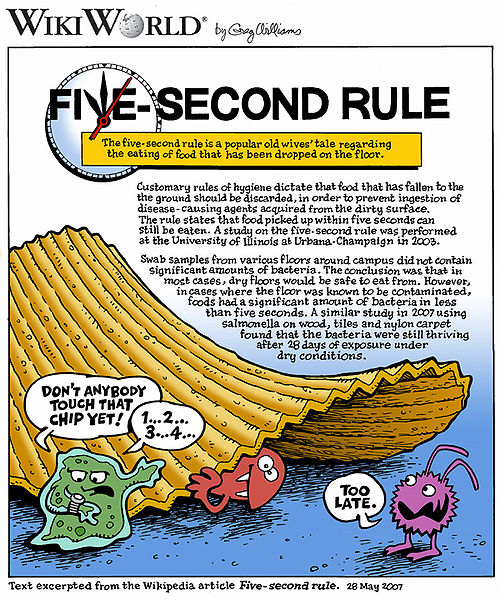
3 second rule

By Greg Williams  for Wikipedia

This was reported recently in the Daily Mail :
To many of us, it is second nature to apply the age-old pseudo-scientific 'three second rule' on such occasions, telling ourselves we're safe if the food hit the floor only momentarily. 
The idea that food is not contaminated if it is retrieved quickly has been believed for many years - but there has not been extensive proof that this is the case.
Now though, the doubt is out as scientists have finally investigated the theory to discover whether the rule is fact or fiction.  
Five food items were tested by Manchester Metropolitan University (MMU) to see whether the three-second rule could be trusted.
Read more: http://www.dailymail.co.uk/femail/article-2138777/The-second-rule-fact-fiction-Scientists-reveal-food-dropped-floor-safe-eat.html#ixzz1wSI1dEUG

Then this interesting analysis of science reporting was also published in  New Scientist:
http://www.newscientist.com/article/dn21864-dodgy-tales-of-research-swirling-the-globe.html?page=1
This article reveals that the "scientists and researchers" mentioned in the first article was actually a single lab tech with financial support from the cleaning supplies company Vileda.

The article goes on to describe the British reporting as entertainment and relatively honest in describing the claims as slightly dodgy but that as it is spread across the world some info gets lost:
 It could have something to do with the history of science coverage in both countries, he said. American journalism started to professionalise in 1934, with the formation of the National Association of Science Writers. "Then, in the '40s, '50s and '60s, the empire strikes back."
As the scientific establishment grew in wealth and influence after World War II, its leaders began to push their own, conservative agenda on the members of the NASW. They doubled down on the idea that only "legitimate science" – that is to say, studies that were peer-reviewed and published in academic journals – should be reported to the public. The real science news, they said, was Big Science news. American journalists learned to follow their rules.
Could things have developed along a different path in Britain? While mulling this over – and chanting USA! USA! to myself in front of the computer – I noticed something about all these lousy British science stories that had escaped my attention. Yes, they described fake studies conducted by disreputable scientists, and they used the data to promote a product. But they were honest about it. Almost every story announced its lack of quality without shame or serious effort at deception. Scientists at Manchester Metropolitan University studied the five-second rule; a cleaning-supplies company called Vileda paid for the work; and now for a message from our sponsor…
But when the stories drift to the US via aggregator sites and blogs and TV news programmes, that transparency can boil right off. The five-second rule has "long been considered an old wives' tale, but now actual scientists are actually testing it," said a reporter on Good Morning America – with no mention of the cleaning supplies outfit that sponsored the research. NeitherThe Huffington Post nor Gizmodo pointed out the conflict of interest. That's the danger of receiving this crap from overseas: once it gets here, we repackage it in the self-serious American style. What starts out as entertainment ends up looking like real news.

This is one reason why anything you read in papers or online should be taken with a grain of salt unless/until you can find corroboration elsewhere or it is actually from a peer-reviewed paper. We see this a lot with all the "magic bullet/foods" that are published these days.  We need periodic reminders to be wary of snake oil salesmen...

Wednesday, May 16, 2012

Always a good time for chocolate

Another interesting and delicious webinar from the American Chemical Society:

From Cocoa Buds to Taste Buds – The Chocolate Process and Sensory Experience


Starting with Olmecs, Mayans and Aztecs, chocolate began some 2,000 years ago. It’s been described as the gift of gods, as well as “sinfully dark.” It’s a gift of love and a source of contention. It is a cherished comfort food, appetite suppressor and health remedy. So what chemistry is behind this alluring treat? Join us with Dr. Greg Ziegler as he melds the process and the sensory experience of chocolate!


Download Presentation Slides (available within one week after the webinar)

“From Cocoa Buds to Taste Buds – The Chocolate Process and Sensory Experience” A short presentation followed by Q&A with speaker, Dr. Greg Ziegler, Penn State University.

What You Will Learn
  • How chocolate is made.
  • Natural and social history of chocolate consumption.
  • Active chemical constituents of chocolate.
  • Unique sensory attributes of chocolate.
  • And much more…

Webinar Details
Date: Thursday, May 17, 2012
Time: 2:00-3:00 pm ET
Fee: Free

Wednesday, April 18, 2012

Sci-fi food

Intriguing article on foods from science fiction books and movies:


"ChickieNobs or soylent green, anyone?" 
The Sydney Morning Herald
April 17, 2012
http://www.smh.com.au/entertainment/blogs/table-talk/chickienobs-or-soylent-green-anyone-20120416-1x33c.html#ixzz1sOrOztiO
In fact, ever since watching The Jetsons as a kid, I’ve been fascinated by the way ‘science fiction’ is often more science than fiction. Food is one of the writer’s favourite devices, one that immediately illustrates the culture of the time, whether it’s two thousand years in the past, or the future.

And here is a related article:


Blessed are the geeks
The Sydney Morning Herald
April 17, 2012 
http://www.smh.com.au/entertainment/restaurants-and-bars/blessed-are-the-geeks-20120417-1x4hn.html#ixzz1sOt8gt7w
England's celebrated jelly-makers and architectural foodsmiths Sam Bompas and Harry Parr have seen the future. Not only that, they've cooked it. Working with micronutritionists, biochemists and nanotechnologists, they recently staged a dinner for KitchenAid in London that featured bioluminescent lollipops, insect-protein pasta and ChickieNobs.

Monday, April 9, 2012

Popcorn anyone?

Another ACS food chemistry seminar:

The Chemistry Magic Behind Popcorn

Discoveries in Mexico and Peru suggest that the earliest popcorn parties date back to cave people thousands of years ago. Undoubtedly, in roasting corn over an open fire and quickly collecting the popped kernels, the three-second rule was born. Legend has it that popped corn was first shared with the pilgrims during the first Thanksgiving. In modern times, popcorn has exploded as a favorite snack in the United States and is fast bursting into international fame. Americans consume an estimated 17 billion quarts of the white fluffy stuff every year. How has chemistry aided in making popcorn a favorite treat?
 Love these seminars!!  If you can't make the live date of April 19th, 2012 for this one, the archived version is available about a week later.  
The Q&A is always interesting since you can send in questions too.

Tuesday, March 6, 2012

That last bite is the best - because it is the last!!


Psychological Science 23(2) 163–165 (2012)
DOI: 10.1177/0956797611427408


The researchers used 5 different flavoured chocolates to see if the test subjects found a difference in the taste of the last one.  The hypothesis was that knowing that something is ending makes it all that much more important to you.  The subjects were given the chocolates randomly and asked to rate the flavours.  When given the fifth one, the subjects were either told that it was the "next one" or the "last one".  When told it was the "last one" about 64% of the subjects rated the last one their favourite.


Friday, February 24, 2012

The Scientist reviews some new food science books

Capsule Reviews:

Neurogastronomy by Gordon M. Shepherd
Columbia University Press, December 2011
Why Calories Count by Marion Nestle and Malden Nesheim
University of California Press, April 2012
The Kitchen as Laboratory By César Vega, Job Ubbink, and Erik van der Linden, editors
Columbia University Press, January 2012
Fear of Food  by Harvey Levenstein
University of Chicago Press, March 2012