Tuesday, March 6, 2012

That last bite is the best - because it is the last!!


Psychological Science 23(2) 163–165 (2012)
DOI: 10.1177/0956797611427408


The researchers used 5 different flavoured chocolates to see if the test subjects found a difference in the taste of the last one.  The hypothesis was that knowing that something is ending makes it all that much more important to you.  The subjects were given the chocolates randomly and asked to rate the flavours.  When given the fifth one, the subjects were either told that it was the "next one" or the "last one".  When told it was the "last one" about 64% of the subjects rated the last one their favourite.


Friday, February 24, 2012

The Scientist reviews some new food science books

Capsule Reviews:

Neurogastronomy by Gordon M. Shepherd
Columbia University Press, December 2011
Why Calories Count by Marion Nestle and Malden Nesheim
University of California Press, April 2012
The Kitchen as Laboratory By César Vega, Job Ubbink, and Erik van der Linden, editors
Columbia University Press, January 2012
Fear of Food  by Harvey Levenstein
University of Chicago Press, March 2012

Monday, February 13, 2012

Miracle fruit decoded

From the February edition of The Scientist
Imagine sucking on a lemon that tastes as sweet as honey, or munching on what you think is a crunchy candy only to discover it’s a pickled onion. Such is the taste-bud trickery experienced at so-called flavor-tripping parties. The secret to the flavorful deceptions is a small red berry from West Africa called miracle fruit, which itself has very little flavor, but can make sour or acidic foods taste extremely sweet when eaten soon after the berry contacts the tongue. So bizarre is the fruit’s effect that just one taste was enough to convince Japanese food scientist Keiko Abe, of the University of Tokyo, to launch into an entirely new area of study.
http://the-scientist.com/2012/02/01/sweet-and-sour-science/trackback/

Tuesday, January 24, 2012

Flavour - a new journal

Flavour is now looking for submissions!!
Flavour is a peer-reviewed, open access, online journal that publishes interdisciplinary articles on flavour, its generation and perception, and its influence on behaviour and nutrition. We seek articles on the psychophysical, psychological and chemical aspects of flavour as well as those taking brain imaging approaches. We take flavour to be the experience of eating food as mediated through all the senses. Thus we welcome articles that deal with not only taste and aroma, but also chemesthesis, texture and all the senses as they relate to the perception of flavour.
 Sounds like it will create lots of fodder for this blog (pun intended)!!
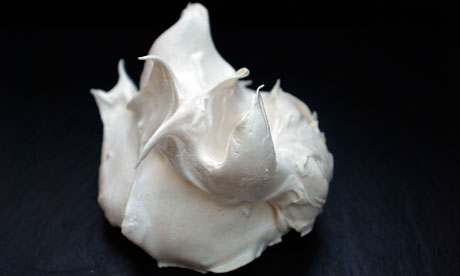
Egg white chemistry

Here is a cool post from the Smithsonian about meringue:
http://blogs.smithsonianmag.com/food/2012/01/meringue-chemistry-the-secrets-of-fluff/

Felicity's perfect meringue. Photograph: Felicity Cloake
and another one from the Guardian:
http://www.guardian.co.uk/lifeandstyle/wordofmouth/2010/aug/19/how-to-make-perfect-meringue

And a very detailed description of all aspects of a lemon meringue pie from Procrastibaking:
http://procrastibaking.co.uk/2011/06/01/the-biochemistry-of-lemon-meringue-pie/

I never really like the meringue on lemon pie and my mom just folded it into the lemon for lemon chiffon pie instead...yummm...but the same tricks apply to make sure it does not lose its fluff.


Wednesday, November 16, 2011

UK's cheapest meal - a toast sandwich

The Royal Society of Chemistry announced today that it has identified the cheapest meal you can make - a toast sandwich for 7.5p (about $0.12 Canadian).

Recipe: Toast a piece of bread  - cool to room temperature.  Place bread between two buttered slices of fresh bread and add salt and pepper to taste.

Great for invalids or the elderly back in the 1800s.

They have even offered a reward if anyone can make a cheaper meal that has as many calories!
Toast Sandwich recipe from Mrs Beeton's cookbook